Fair Shift: Compliance in Action
Managers could pass a policy quiz. When a real situation walked through the door, the policy went blank.
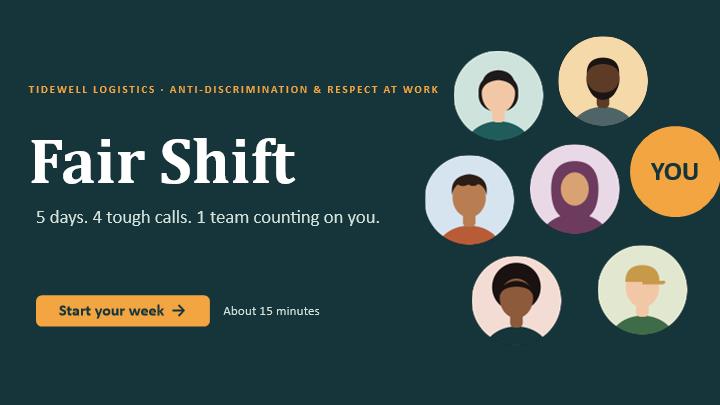
Project Overview
The Audience
Front-line managers and supervisors at a regional logistics and distribution company, responsible for day-to-day operational and people decisions.
Responsibilities
- Instructional Design: Action Mapping, Storyboarding, Scenario Scripting.
- eLearning Development: Full Storyline build with branching and character audio.
Tools Used
The Problem
This module was submitted for a monthly community challenge for instructional designers. The brief presented a real pattern: an HR manager named Mark used an AI tool to generate a mandatory anti-discrimination training and called it done. No needs analysis, no scenarios, no branching. Policy text, generic images, and a quiz where learners could guess the right answer without ever having been put in a real situation.
The performance gap was familiar: managers could pass the quiz. Recite EEOC, ADA, Title VII. But when an actual situation interrupted the workday - a biased comment in a hiring debrief, a temp worker reporting harassment, a retaliation risk forming quietly after an HR complaint - the policy disappeared from practice.
The challenge: redesign it from the ground up as a performance-based experience.
The Solution
I designed a scenario-based Storyline module set at Tidewell (a fictional regional logistics company), dropping learners into the role of a warehouse supervisor during a single work week. Each scene surfaces a different compliance challenge inside real operations: a biased comment in a hiring debrief, a temp worker experiencing racial harassment, an employee requesting a religious accommodation, a retaliation risk forming quietly after an HR report.
The framing was deliberate: "You'll make a hundred calls this week about trucks and schedules. A few will be about people. Those matter most." Embedding compliance decisions inside the operational context managers actually live in forces recognition and judgment rather than policy recall.
The Process
Using the ADDIE model, I identified the specific moments where compliance knowledge breaks down in practice, then built scenarios around those exact failure points — prioritizing recognition and judgment over definition and recall.
Action Mapping
I mapped the specific moments where HR judgment breaks down in a logistics context — not generic policy gaps, but the real pressure points: a hiring debrief with a casual age comment, a harassment report involving a temp worker where the manager assumes it's the agency's responsibility, a schedule change after an HR complaint that looks routine but constitutes retaliation. Each scenario was built directly from an identified gap.
Learning Objectives
Each objective targets a recognized failure point: not policy definitions, but applied judgment in context.
Identify legally protected characteristics at risk in realistic hiring and promotion conversations.
Respond appropriately to accommodation requests under the ADA and Title VII in an operational context.
Recognize and interrupt harassment scenarios, including those involving third-party workers.
Apply anti-retaliation standards when an employee who filed an HR complaint is reassigned or referenced.
Scenario Scripting
Before opening Storyline, I scripted each scenario as a branching dialogue — the character's words, the manager's available choices, and the consequence logic. The goal was to make compliance situations feel like interruptions inside a real workday, not standalone ethics puzzles. Each scenario was reviewed for legal accuracy and calibrated so that wrong choices have plausible-sounding reasoning, not obvious tells.
The module opens with the framing line that anchors the design: “You'll make a hundred calls this week about trucks and schedules. A few will be about people. Those matter most.”
Full Development
Built in Articulate Storyline with character voiceover, branching logic, and consequence-driven feedback layers. Each scenario runs on conditional variables tracking decision patterns, not just right/wrong per question, but the cumulative shape of a manager's judgment over the week. The module is ~4 minutes, 35 slides, SCORM-packaged for LMS deployment.
Key Takeaways
Three things that made this work
Compliance training fails when it feels like a test of what you already know. Every design choice here was aimed at creating situations where the right answer isn't obvious until the manager actually thinks it through.
The Operational Frame
Setting each scenario inside a real workday — dispatching trucks, managing schedules, handling a shift change — meant compliance situations arrived as interruptions, exactly as they do in real life. The operational frame prevented managers from shifting into 'compliance test mode' and forced genuine in-context judgment.
Third-Party and Temp Worker Scenarios
One of the most common real-world gaps: managers assuming that harassment or discrimination involving agency staff is 'the agency's problem.' A deliberate scenario — a temp worker being racially harassed on the floor — directly targets this belief and demonstrates employer liability regardless of employment status.
Retaliation as a Slow Build
Retaliation rarely looks like a punishing act. It looks like a reasonable schedule change, a reference call gone wrong. Rather than presenting retaliation as an obvious villain move, the module staged it as a series of small decisions — each one individually justifiable, together forming a pattern managers need to recognize.
Live Demo
Experience the Module
The full Articulate Storyline module — scenario-based, branching, with character audio and consequence-driven feedback. Best experienced on desktop.
Launch Module