Perfect Pair: LG Product Knowledge
LG field reps know the products. The challenge is showing store associates how to start the conversation, not recite the spec sheet.
Project Overview
The Audience
LG field reps who coach store associates at Best Buy, Home Depot, and Lowe's - helping them start pairing conversations with customers and recommend products as helpful solutions rather than a sales pitch.
Responsibilities
- Instructional Design: Needs Analysis, Storyboarding, Scenario Design.
- eLearning Development: Storyline build with embedded customer video scenarios.
Tools Used
The Problem
LG field reps who coach store associates at Best Buy, Home Depot, and Lowe's already know the product line well. The gap isn't product knowledge. It's conversational confidence: how do you show an associate to suggest a paired product as a helpful recommendation rather than a hard sell? And how do you do that standing on a sales floor, between store visits, with five minutes and no materials handy?
Since store associates learn by watching reps, the training had to model the exact language and moves reps want associates to repeat with customers.
The Solution
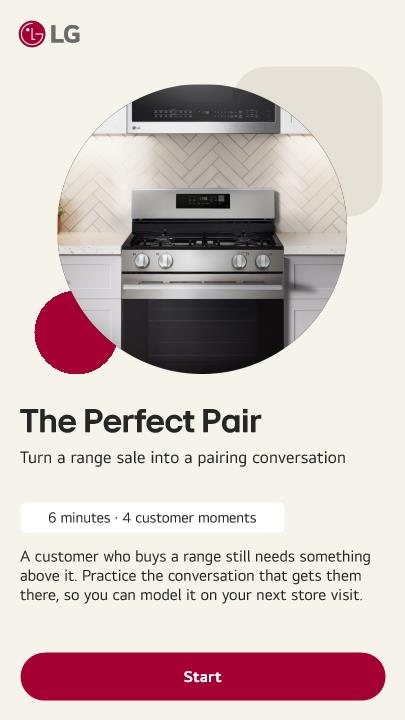
I designed a mobile-first microlearning built for one-handed use on a phone between store visits. The module runs about 6 minutes across 11 screens, built around three steps: ask the right questions, suggest a pair, and address customer concerns.
Learners step into the role of a rep coaching a store associate named Jordan through two real customer situations. Dana needs an over-the-range microwave replacement but has limited counter space. Sam is a high-heat home cook who has been triggering smoke alarms for years. Working through how Jordan handles each customer builds the rep's ability to model these conversations on the sales floor.
The last screen gives reps a 4-point quick reference they can screenshot and pull up during their next store visit.
The Process
I started with how and where reps actually use training: on their phones, between stops, often with sound off. Every design decision traces back to that context.
Needs Analysis
The core gap wasn't product knowledge - field reps already know the LG line well. The gap was conversational: reps needed to show store associates how to start a pairing conversation and position a second product as helpful rather than pushy. Needs analysis focused on the specific moments in a sales floor conversation where associates typically lose the thread or default to spec-listing.
Learning Objectives
Three objectives, all framed around the coaching conversation.
Guide a store associate to ask qualifying questions that surface a customer's actual cooking habits and space constraints.
Suggest a product pairing as a helpful recommendation in response to what the customer described, not a sales pitch.
Address common customer concerns (space, budget, "I just need a range") without losing the pairing conversation.
Scenario Design
Learners step into the role of a field rep coaching a store associate named Jordan through two customer situations. Dana needs an over-the-range microwave but has limited counter space. Sam is a high-heat home cook who has been triggering smoke alarms for years. The two scenarios test whether reps can coach Jordan to match products to what the customer actually described, not give the same pitch twice.
Each customer is brought to life through illustrated characters with optional voiceover, so the experience starts with listening before it asks for a product recommendation. Reps with sound off get clear visual cues that carry the same meaning.
Full Development
Built in Articulate Storyline with a vertical mobile-first layout, illustrated customer characters with optional voiceover, and interactive product-matching questions. The module runs about 6 minutes across 11 screens, short enough to complete between store visits on a phone. The final screen is a 4-point quick reference reps can screenshot for use on the sales floor. SCORM-packaged for LMS deployment.
Key Takeaways
Three things that made this work
Three choices that shaped how this training works - and why it fits the rep's day instead of fighting it.
Mobile-First, Vertical Format
Reps complete this between store visits, usually on their phones. The vertical format makes it fully one-handed with no pinching or rotating. On a desktop it renders as a centered column. The format was decided before the first screen was written.
Audio Optional, Always Clear
Customer characters Dana and Sam have voiceovers for reps who want to hear the conversation tone. But every interaction works just as well with sound off. Reps on a busy sales floor shouldn't have to find headphones to train.
One Pair, Practiced Well
The module covers one stove paired with either an over-the-range microwave or a vent hood. Not the full LG catalog - one pairing decision, practiced twice, across two distinct customer situations. Building one skill well beats surveying five products loosely.
Live Demo
Experience the Module
The full Articulate Storyline module - customer video scenarios, product matching interactions, and immediate feedback. Works on mobile and desktop.
Launch Module