OmniReach: The 10k Values Challenge
The employees knew the values. Under pressure, they defaulted to the safe path anyway. I built a marathon to change that.
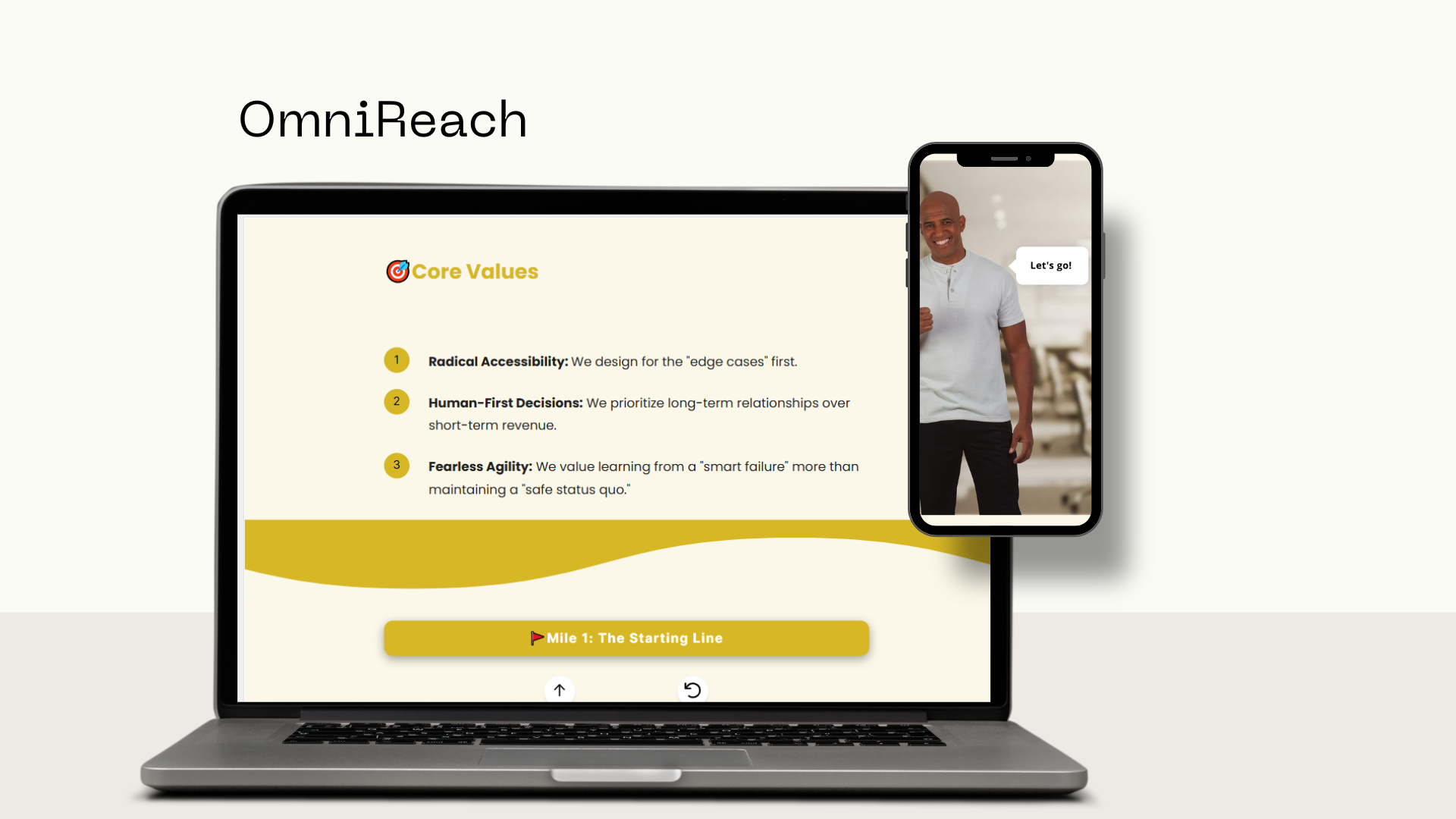
Project Overview
The Audience
New employees at OmniReach — all staff members onboarding into the company, learning to apply the three core values in real operational scenarios from day one.
Responsibilities
- Instructional Design: Action mapping, storyboarding, visual design, prototyping, authoring.
- eLearning Development: Full lifecycle creation in Rise 360.
Tools Used
The Problem
OmniReach has clearly defined core corporate values — Radical Accessibility, Human-First Decisions, and Fearless Agility. However, internal leadership noticed a disconnect between theoretical alignment and real-world behavior.
In day-to-day operations, employees faced intense compliance and revenue pressures (such as pushing tight deadlines, maximizing short-term account renewals, and managing executive visibility during project missteps). Without a safe environment to practice navigating these high-stakes trade-offs, employees frequently defaulted to a "safe status quo" or prioritized short-term financial gains over long-term customer relationships and radical inclusion metrics.
The traditional employee handbook was failing to drive behavior change, resulting in operational "stumbles" that compromised brand integrity and core mission alignment.
The Solution
To bridge this gap, we designed the OmniReach 10k Value Challenge — a highly contextualized, scenario-based gamified eLearning experience built inside Articulate Rise 360.
Using a sports-performance "marathon" theme to mirror professional growth, the training frames compliance and values as active behavioral choices rather than rigid rules. Learners navigate realistic "Course Challenges" alongside virtual Pacers who act as coaches.
Instead of a standard pass/fail score, choices dynamically feed into a Performance Dashboard tracking three distinct behavioral variables: Stamina (adherence to Radical Accessibility under tight deadlines), Pace (practicing Fearless Agility through "Smart Failures"), and The Crowd (cultivating trust and long-term customer capital). By introducing choice-specific branching feedback, learners immediately witness the direct structural impact of their operational decisions.
The Process
"Backward-designing through the ADDIE model, I created a highly resonant learning experience - bridging content to learners' past experiences, anchoring it in immediate job application, and framing it around a clear problem-and-solution structure."
Action Map
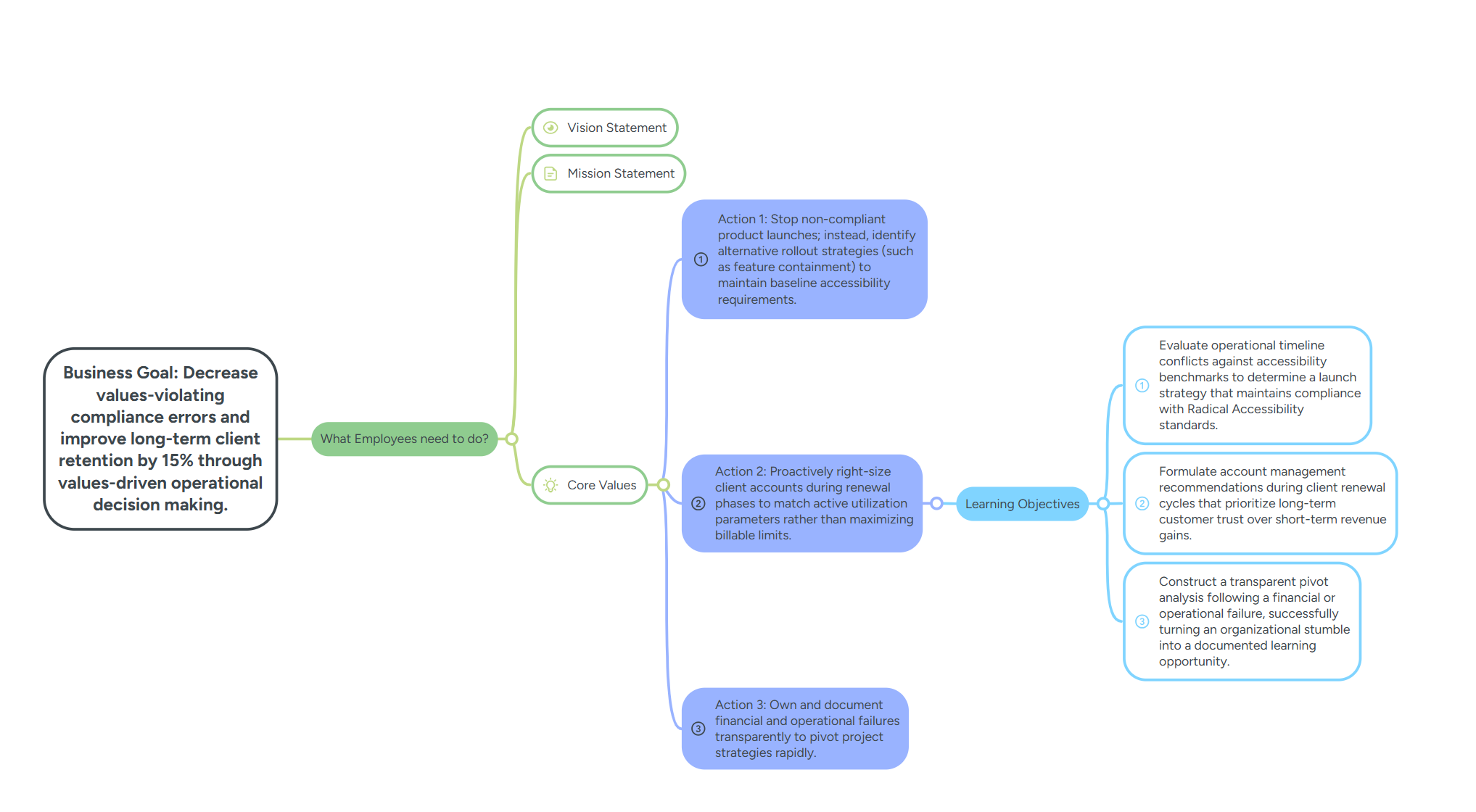
Identified 3 critical pressure moments where values are hardest to act on in real job situations - not generic ethics scenarios, but actual recurring operational conflicts mapped directly to performance gaps.
Learning Objectives
Mapped directly to the three OmniReach core values — Radical Accessibility, Human-First Decisions, and Fearless Agility.
Evaluate timeline conflicts against accessibility benchmarks without defaulting to client pressure
Formulate account recommendations that prioritize long-term trust over short-term revenue
Construct a transparent pivot analysis that turns an operational failure into a learning opportunity
Text-Based Storyboard
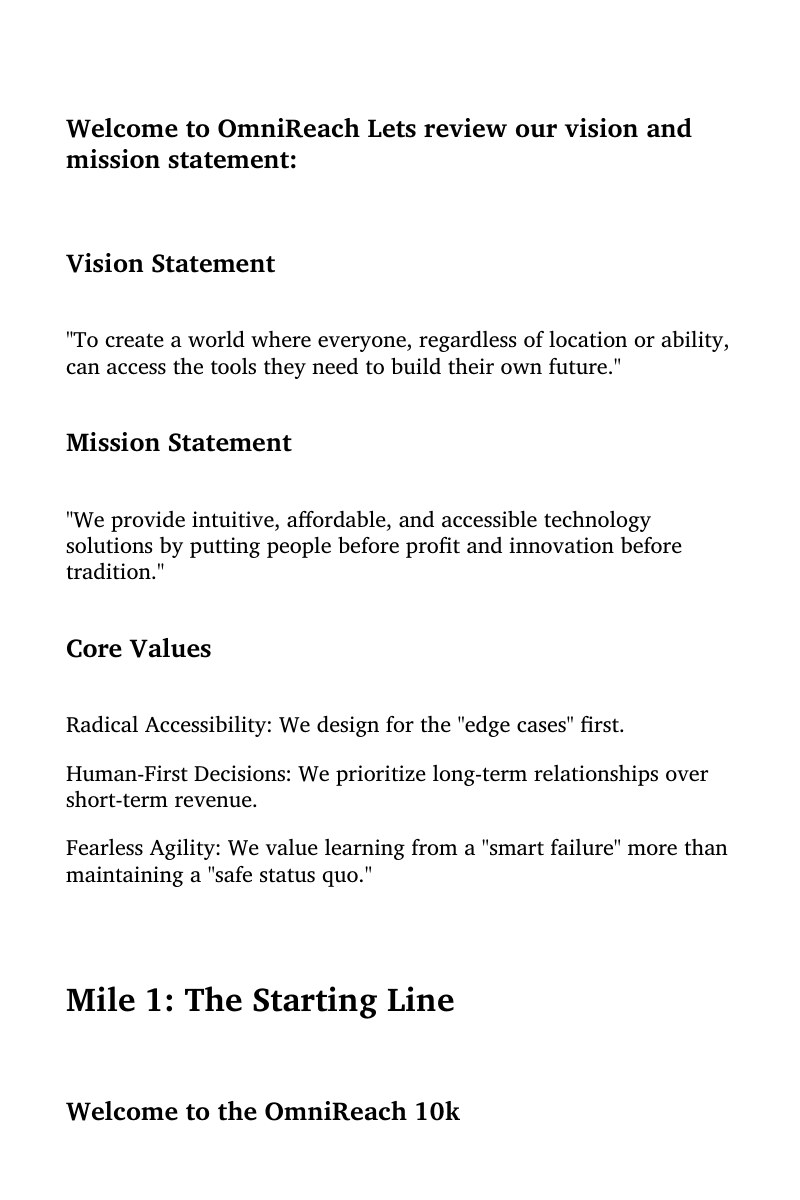
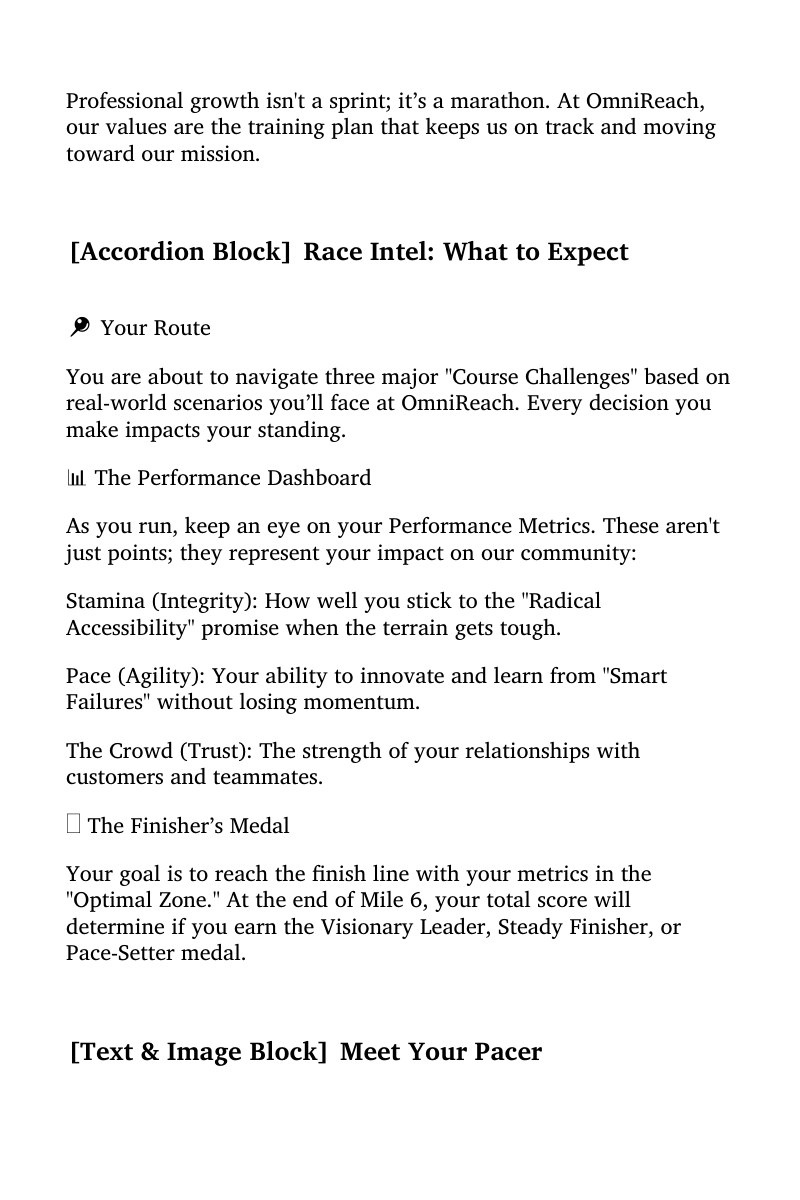
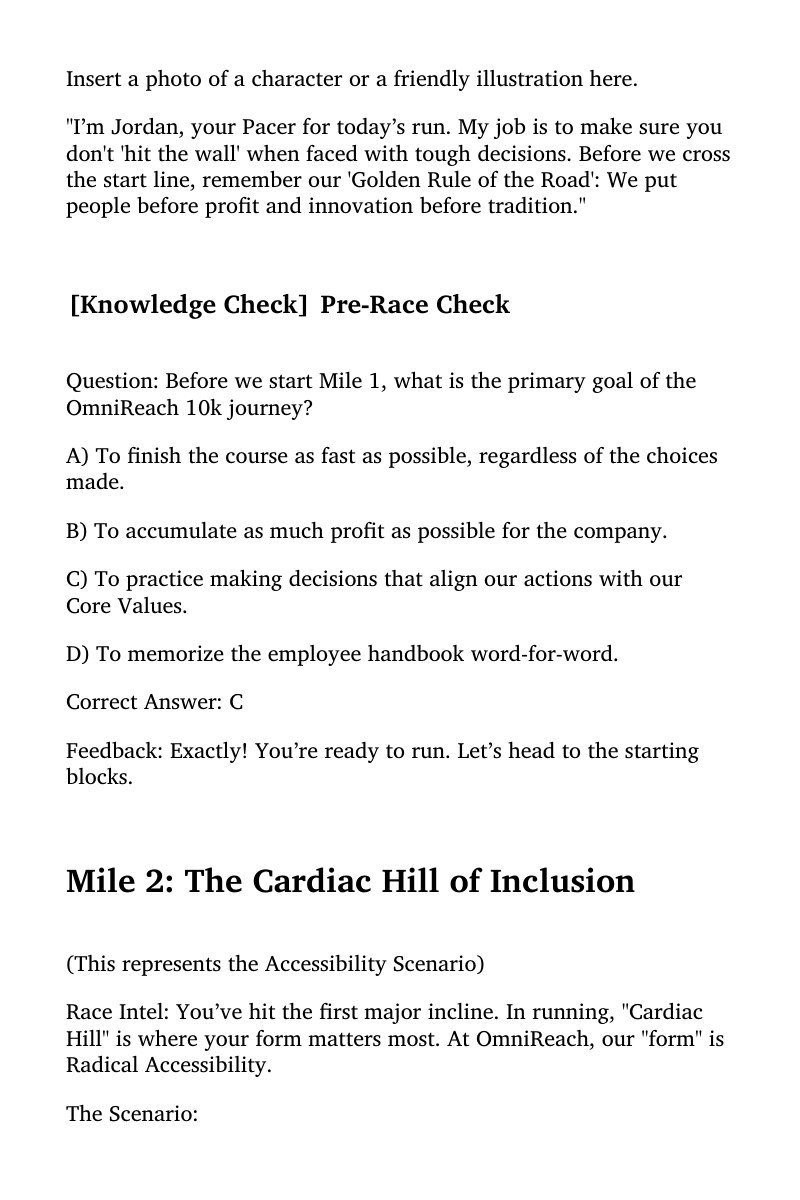
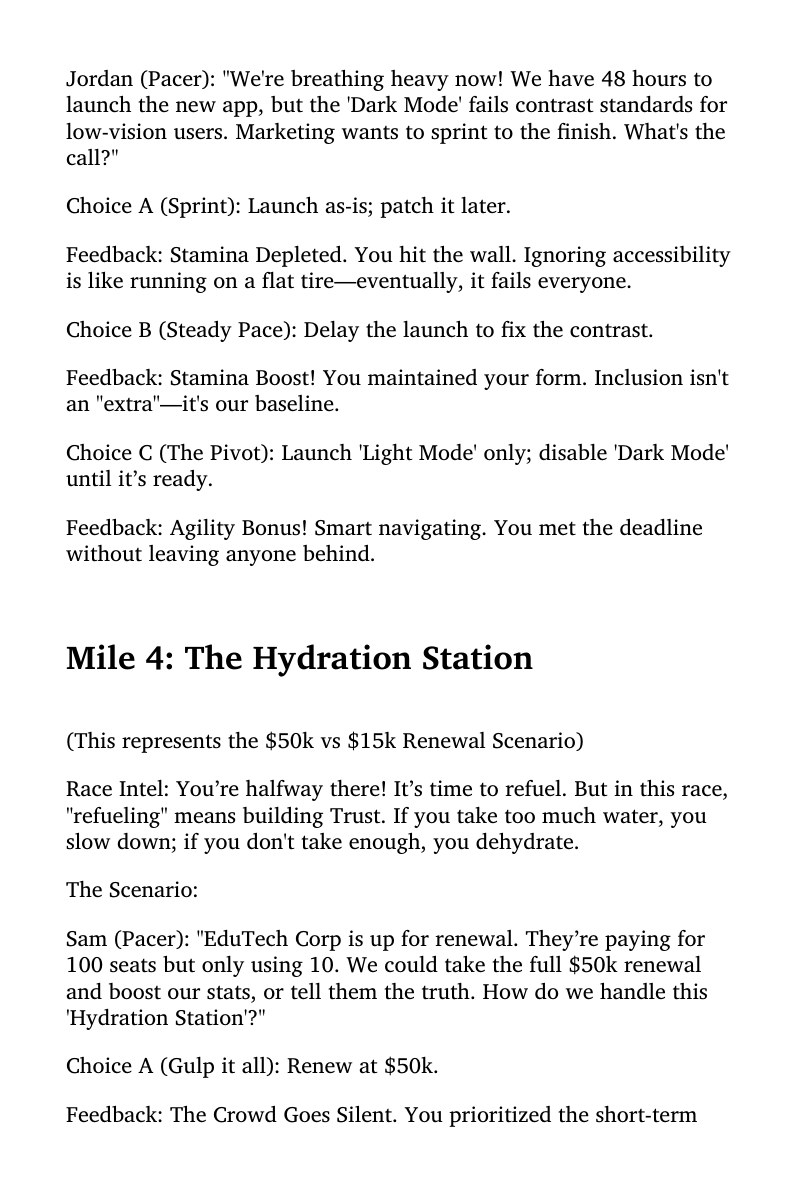
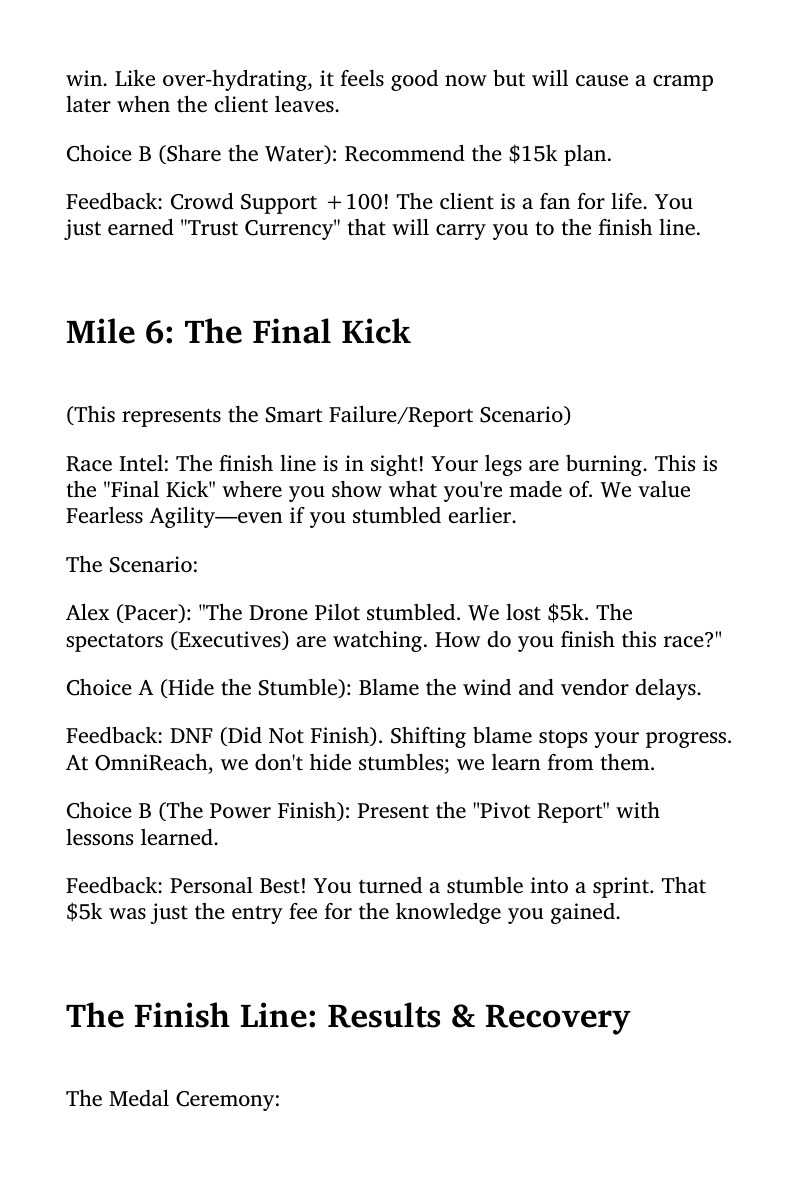
Before designing a single block, I drafted the script, prompt queries, and branching options inside Figma to map out the narrative arc. This allowed me to map out the custom feedback tracks for every choice — such as identifying when a learner's decision would deplete their Stamina or boost their Pace — without getting bogged down by visual assets. Co-designing the text blueprint with stakeholders ensured that the scenario choices directly targeted the core values before moving into the layout phase.
Storyboard Pages — swipe to browse · click to expand

Visual Mockups
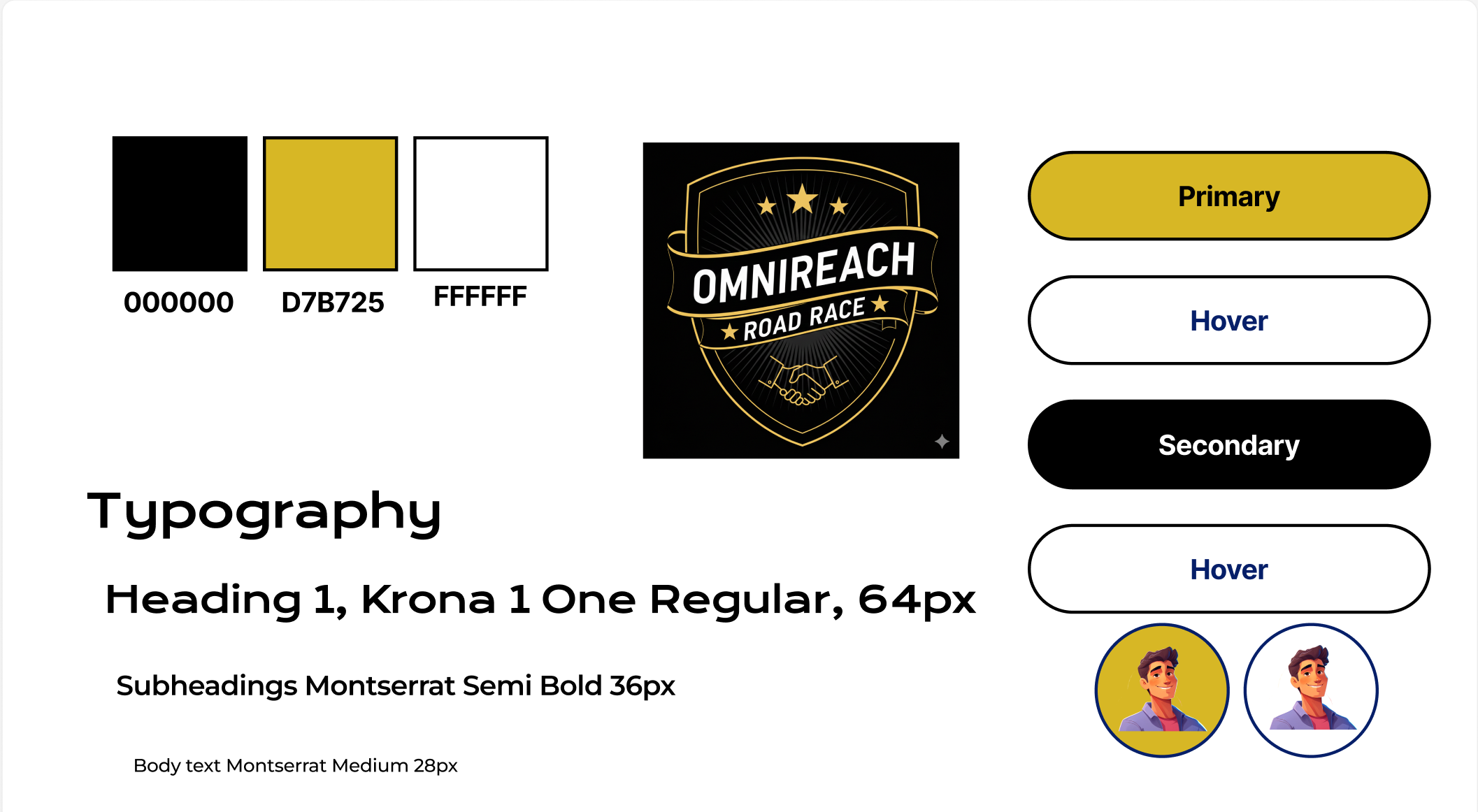
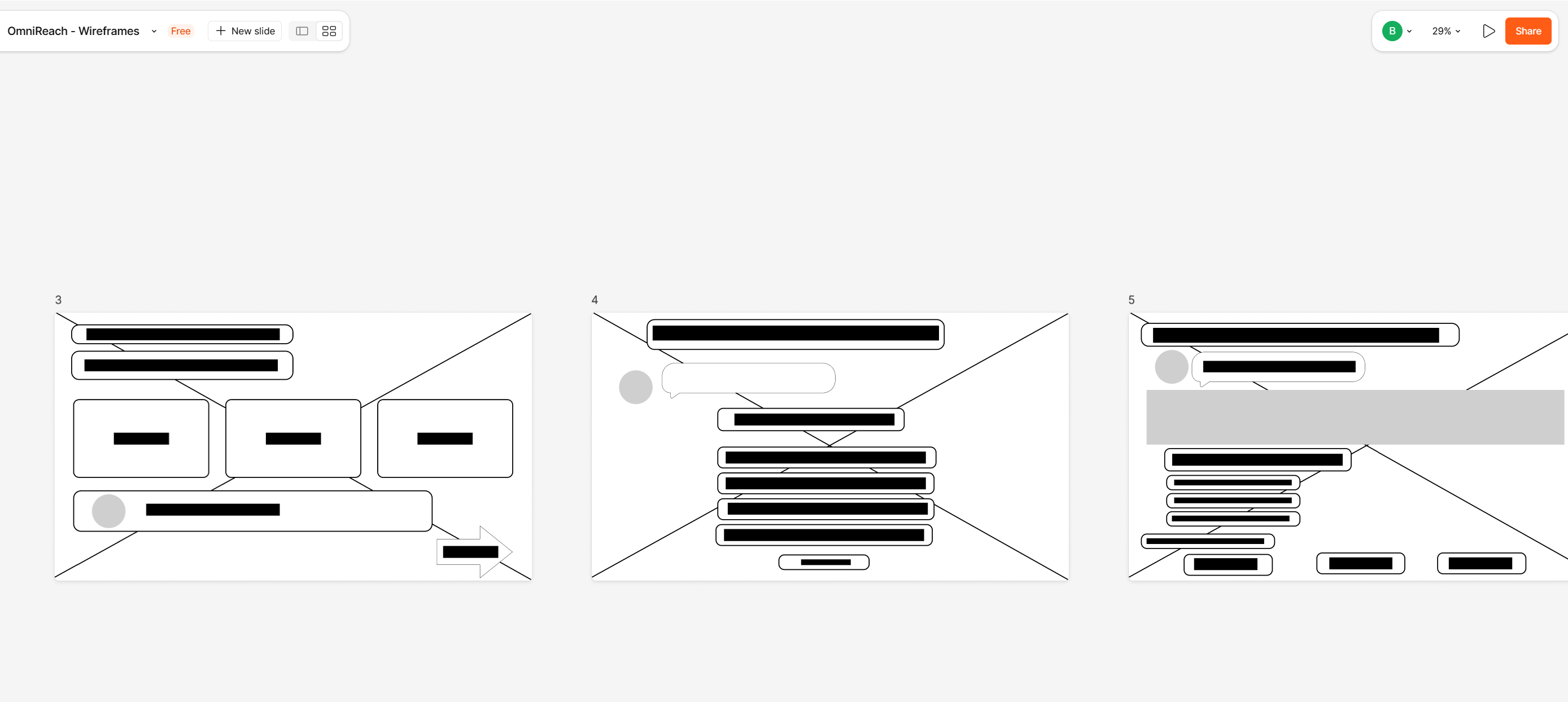
Once the text was locked in, I built low-fidelity visual mock-ups within Figma to design the aesthetic framework of the race theme. I structured clean, distinct text boxes and block layouts — using colored left-border callout styles to represent the Race Intel and Scenario Rooms — to mimic the responsive design of a modern interface. This process allowed stakeholders to review the content's visual hierarchy, text placement, and visual pacing before any building occurred in the authoring tool.
Interactive Prototype
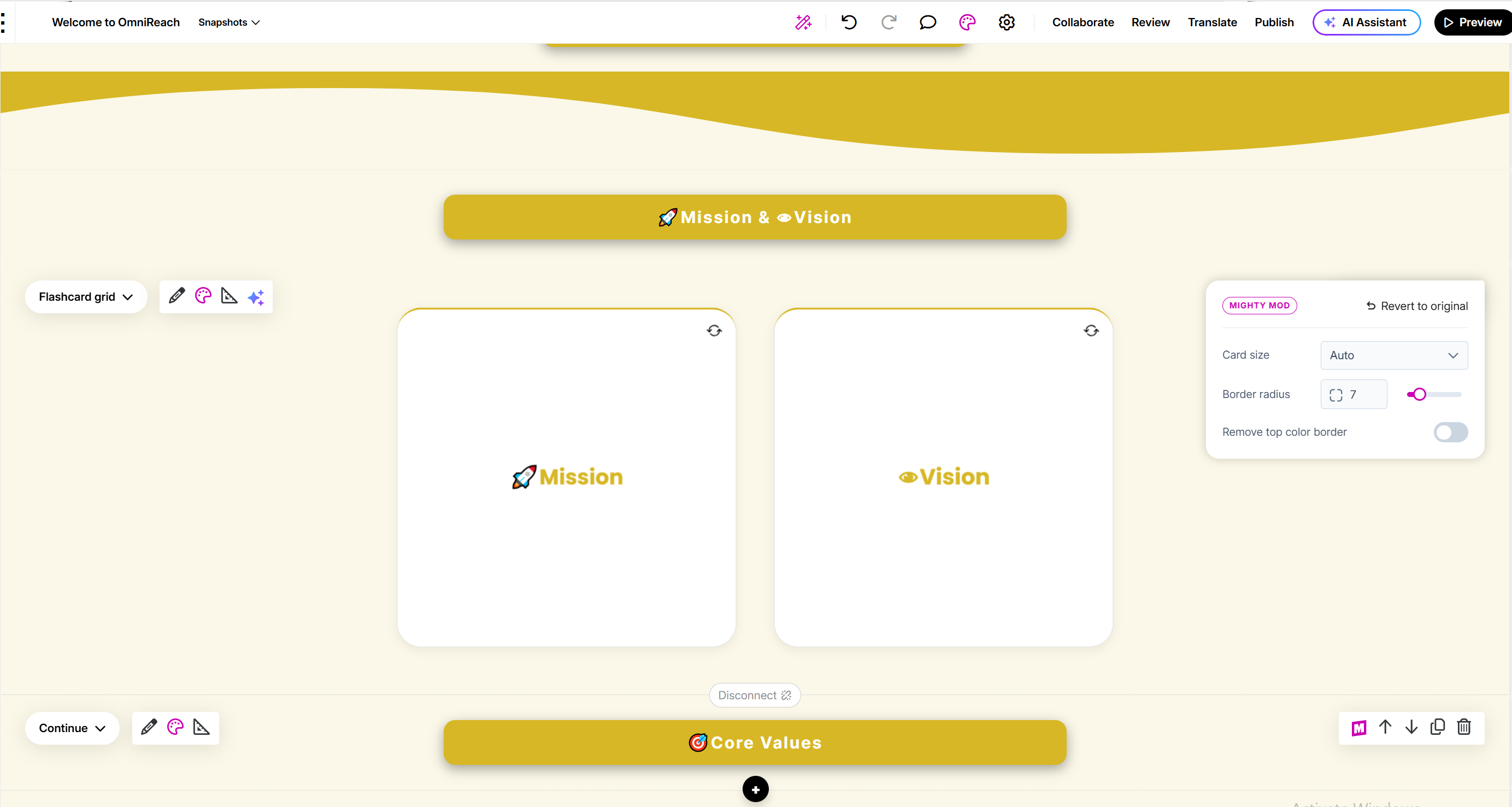
With the visual frameworks approved, I developed a rapid interactive prototype in Articulate Rise 360 to test the navigation rhythm. I mapped out the initial modules utilizing native structural components like accordion blocks for the Race Intel, multiple-choice elements for the scenarios, and flashcard grids for the Core Values Matrix. Building this early proof-of-concept allowed me to verify how the custom branching feedback scaled across both desktop and mobile layouts.
Full Development
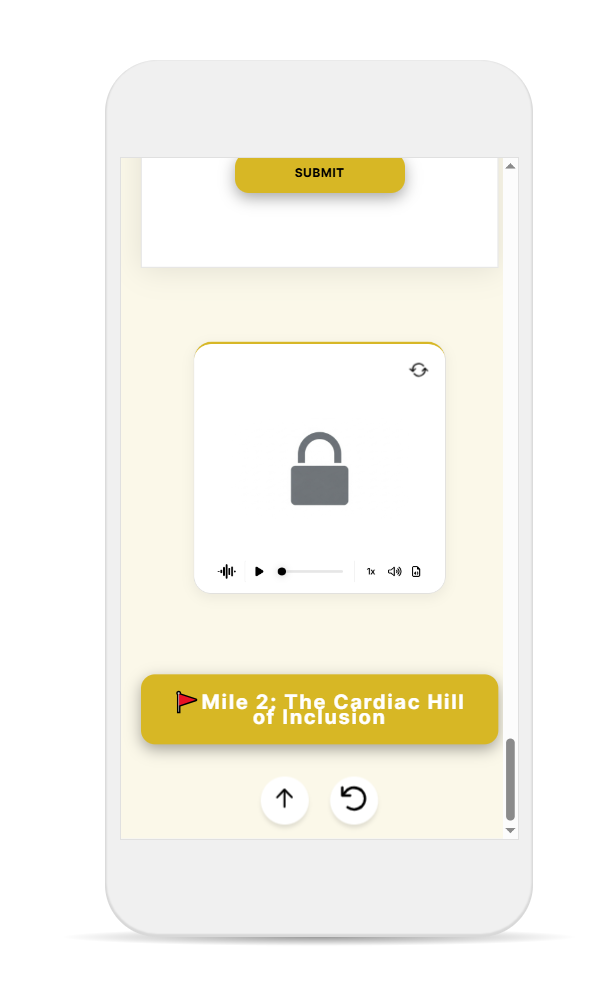
The final phase involved full-scale development, asset integration, and brand layout optimization inside Articulate Rise 360. I built out all remaining miles of the course, refined the thematic header graphics, and embedded creative engineering workarounds — such as using an interactive Tabs Block at the finish line — to let learners self-reflect on their metric totals despite native platform variable limits. The completed project was thoroughly tested to ensure clean responsive performance, delivering a polished, standalone solution ready for deployment.
Key Takeaways
Three things that made this work
The marathon metaphor wasn't decoration. Every design decision connected back to the core insight: values have to be practiced under pressure, not just understood at rest.
The Marathon Metaphor
I chose a marathon because it's honest about difficulty. At kilometer 8, your legs ache and shortcuts look genuinely tempting — that's exactly the pressure employees face with values-aligned decision-making. The metaphor earns the emotional weight of the scenarios.
Three Behavioral Variables
Instead of a pass/fail score, I tracked Stamina (resilience under cost), Pace (consistency across scenarios), and The Crowd (acting on values under social pressure). The dashboard shows which qualities held — and which were traded away.
The Tabs Block Workaround
Rise 360 has native variable limits that made a full performance debrief technically constrained. Rather than surrendering to the platform, I redesigned the finish line: a learner-driven Tabs Block let learners actively review each variable themselves. A constraint became a more intentional reflection moment.
Live Demo
Run the 10k
The full Rise 360 module — three branching scenarios, the Performance Dashboard, and the Tabs Block debrief at the finish line. Best experienced on desktop.
Experience the Project